
FibroScan Interpretation: Normal Values, Liver stiffness (kPa) & CAP Score Explained
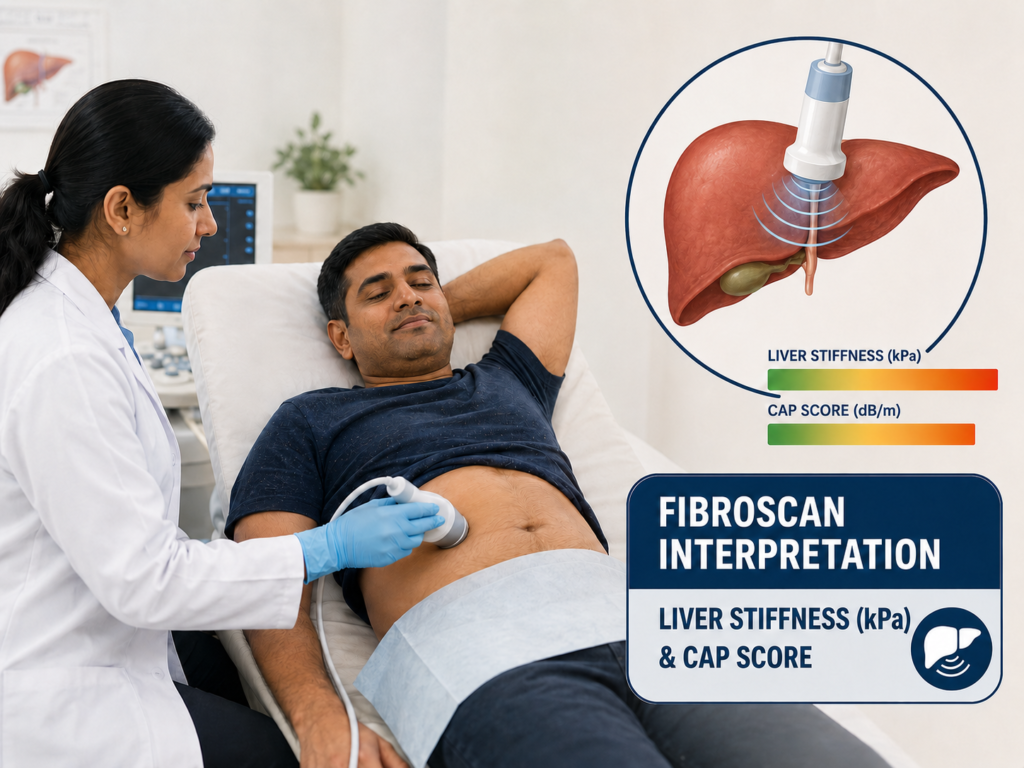
Understanding your liver health report can feel overwhelming. If your doctor has recommended a FibroScan, you might be wondering what numbers like kPa and CAP score mean for your health.
In this comprehensive guide, Dr. Amit Kumar, leading Gastroenterologist in Gurugram, breaks down how to interpret your FibroScan test results.
1.What is FibroScan?
A FibroScan (also known as transient elastography) is a quick, non-invasive marker of liver stiffness and liver fat without requiring a liver biopsy.
2.What are the important values in a FibroScan report?
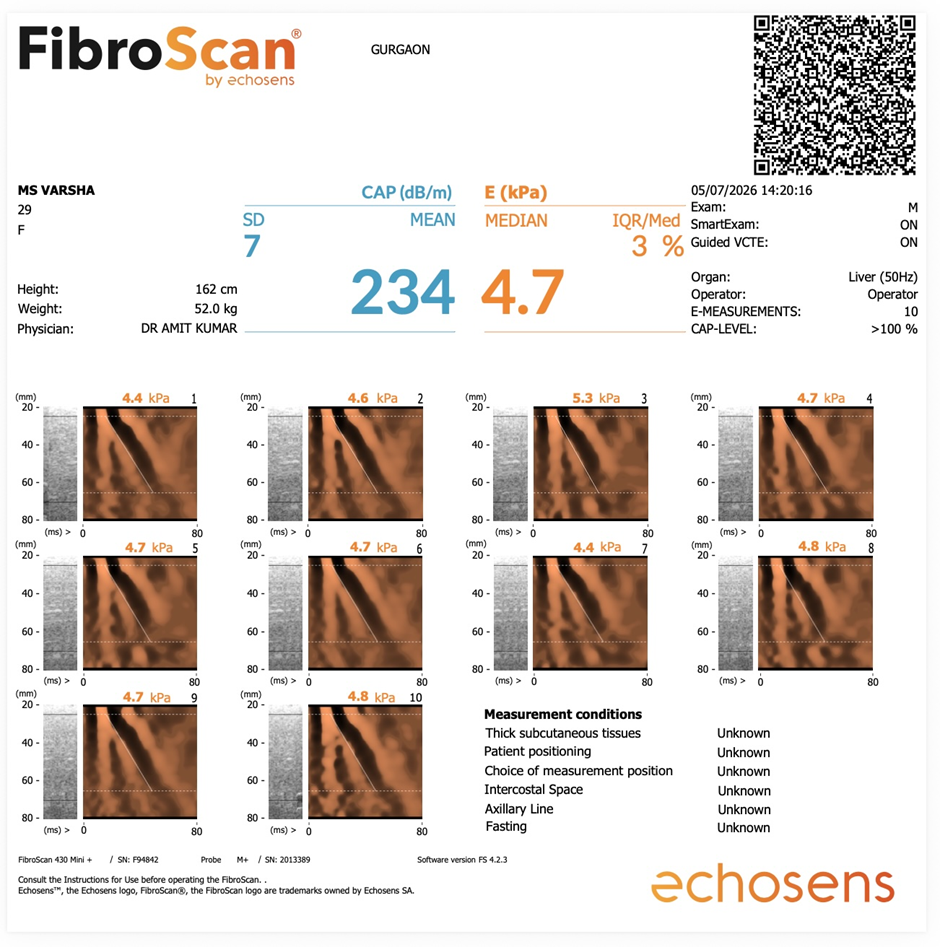
A.Liver Stiffness (LSM)- kPa
Tell’s about liver stiffness (how hard or firm the liver has become).
Healthy liver: Soft and flexible
Stiff liver: Becomes harder due to scarring (fibrosis)
Very Stiff liver: Indicate advanced fibrosis or cirrhosis
B.CAP score- dB/m
CAP stands for Controlled Attenuation Parameter.
It measures the amount of liver fat (steatosis)
C.IQR/ Med
Interquartile range/ Median Stiffness measurement
It tells how consistent/reliable the FibroScan readings.
<30% =Reliable
>30% =Readings are more variable; the results are less reliable.
What is the interpretation of LSM & CAP value?
| Fibrosis Stage | Value | Interpretation |
| F0-F1 | <7 | Normal |
| F2 | 7-10 | Significant Fibrosis |
| F3 | 10-14 | Advanced Fibrosis |
| F4 | >14 | Cirrhosis |
| CAP (dB/m) | Steatosis Grade | Interpretation | Intervention |
| <248 | So | No | No treatment |
| 248-267 | S1 | Mild Fatty liver | Lifestyle modification |
| 268-279 | S2 | Moderate fatty liver | Medicine + exercise |
| >280 | S3 | Severe Fatty Liver | Medicine |
4.When should FibroScan be done?
- Fatty liver / MASLD
- Chronic Hepatitis B or C
- Alcohol related liver disease
- Persistently abnormal LFTs
- Suspected advanced fibrosis or cirrhosis
- Monitoring known chronic liver disease
- Before and after treatment of certain liver disease
5.Can FibroScan detects fatty liver?
Yes, FibroScan can detect fatty liver. For detection of fatty liver we have to refer to CAP value.
6.Can FibroScan detects Cirrhosis?
Yes, FibroScan can detects Cirrhosis. For diagnosing cirrhosis refer to kPa Values.
7.Can FibroScan result be compared with biopsy?
FibroScan has good correlation with biopsy, particularly for advanced fibrosis and cirrhosis, but the correlation is weaker for distinguishing adjacent stages.
8.How is FibroScan done?
Step- by- Step procedure
- Preparation
You are generally advised to fast for around 4 hours before the test. You lie comfortably on your back with your right arm raised behind your head to expose the right side of the abdomen.
- Positioning the probe
Doctor or trained technician applies a hand-held probe in close contact with the abdomen (mainly in right upper abdomen)
- Measurement
The probe sends a vibration through the liver
Machine measures quickly the vibration through the liver
9.How many readings are done in FibroScan?
Ideally, 10 readings are recommended
10.What are the factors which affect FibroScan value?
- Acute hepatic inflammation or elevated liver enzymes
- Cholestasis (Gallbladder blockage)
- Hepatic congestion
- Recent food intake (always fast 4 hours prior)
- Alcohol consumption
- Ascites (Abdominal fluid)
- Liver lesions or inappropriate measurement site
- Obesity
- Probe Selection
11.How much does a FibroScan test cost in Gurugram?
Cost typically ranges from Rs 2500 and Rs 6000. At GastroHeal Liver & Digestive Clinic in Gurugram, we offer tests at Rs 2500, with free screening camps held periodically.
12.When should you consult gastroenterologist?
You should consider consulting a gastroenterologist at GastroHeal liver & Digestive Centre – Dr. Amit Kumar, if you have abnormal LFT, low platelet count, ultrasound findings and medical history to determine whether further evaluation or treatment is required.
